
How to Play Chicken Subway: Complete Rules & Interface Guide
Everything you need to know before placing your first bet. I'll walk you through each element of the interface and explain exactly how the game works.
Watch Chicken Subway in Action
See how the game works before you play. This video shows actual gameplay including track selection, multipliers, and the withdraw mechanic.
Chicken Subway gameplay demonstration
Understanding the Interface
Before you start playing, take a minute to understand what you're looking at. The Chicken Subway interface is cleaner than most casino games, but there are still several elements to track.
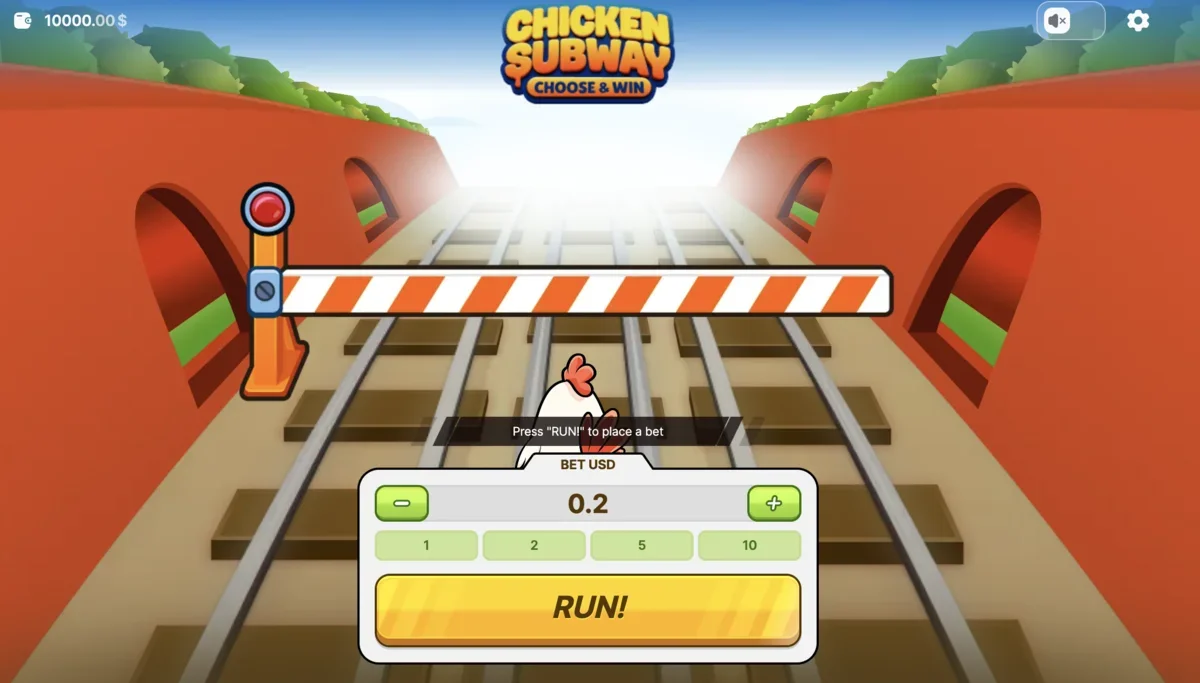
Key Interface Elements
| Element | Location | Function |
|---|---|---|
| Balance | Top left | Shows your current casino balance in USD |
| Bet Amount | Center panel | Current bet value ($0.10 - $150) |
| +/- Buttons | Around bet amount | Adjust bet in small increments |
| Quick Bet Buttons | Below bet amount | Preset values: $1, $2, $5, $10 |
| RUN Button | Bottom center | Starts the round (places your bet) |
| Settings Gear | Top right | Sound, game limits, provably fair info |
During Gameplay
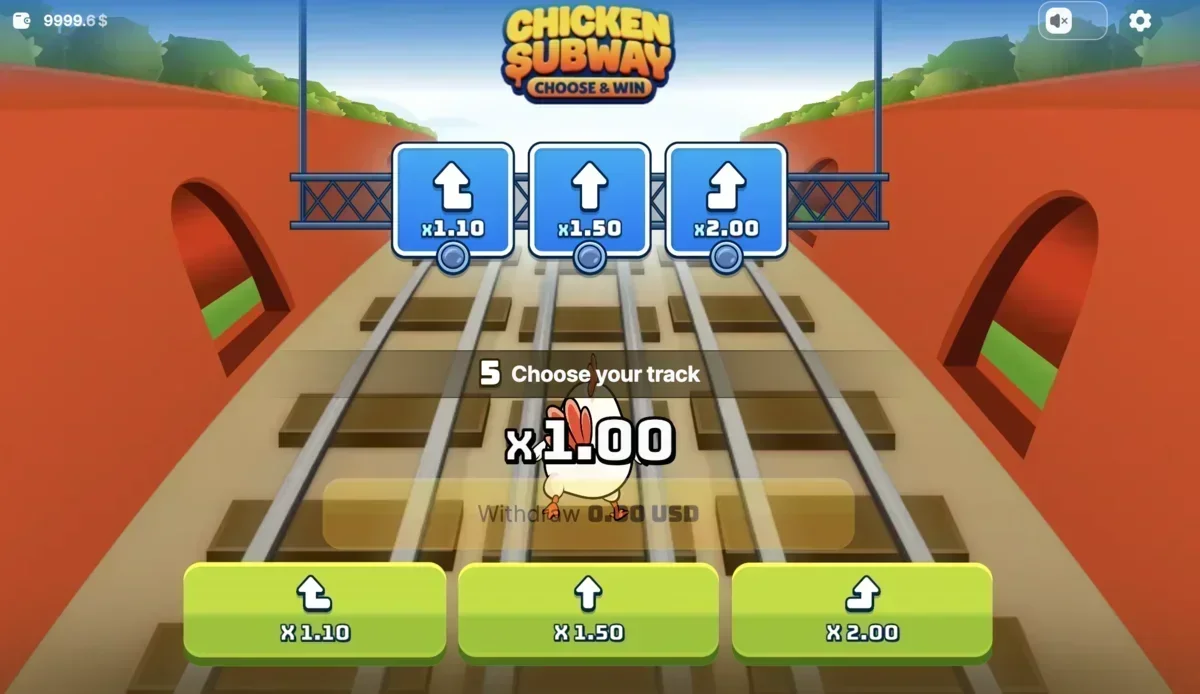
| Element | Location | Function |
|---|---|---|
| Track Options | Top half | Three tracks with different multipliers |
| Current Multiplier | Center | Your accumulated multiplier (starts at x1.00) |
| Track Buttons | Bottom | Click to choose left, center, or right track |
| Withdraw Button | Center (yellow) | Cash out current winnings |
| Timer | Varies | Countdown to auto-select (if enabled) |
Step-by-Step Gameplay
Step 1: Set Your Bet
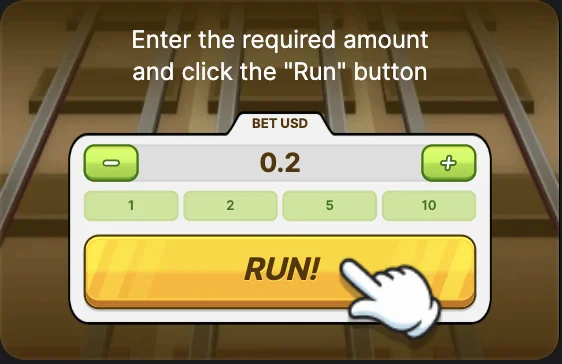
Use the +/- buttons or quick-select values ($1, $2, $5, $10) to set your bet. The minimum is $0.10, maximum is $150.
My recommendation: Start with $0.10-$1 bets until you understand the volatility. I've seen players lose $50 in under 5 minutes betting too aggressively.
Step 2: Press RUN!
Once your bet is set, hit the yellow RUN button. This locks in your bet and starts the round. Your balance decreases by the bet amount immediately.
What happens behind the scenes: The game generates a hidden "crash multiplier" for this round. Your goal is to accumulate multipliers without exceeding this hidden number.
Step 3: Choose Your Track
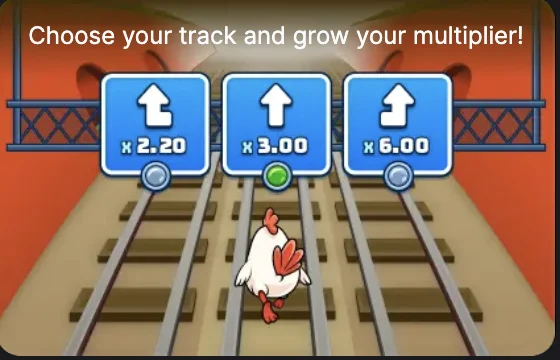
Three tracks appear with different multipliers. Lower multipliers (x1.10, x1.50) are "safer" — higher multipliers (x3.00, x6.00+) are riskier.
Click the track you want. Your chicken runs to it, and if successful:
- Your accumulated multiplier increases
- You see new track options
- The Withdraw button shows your current potential payout
If you exceed the hidden crash multiplier, you lose everything.
Step 4: Withdraw or Continue
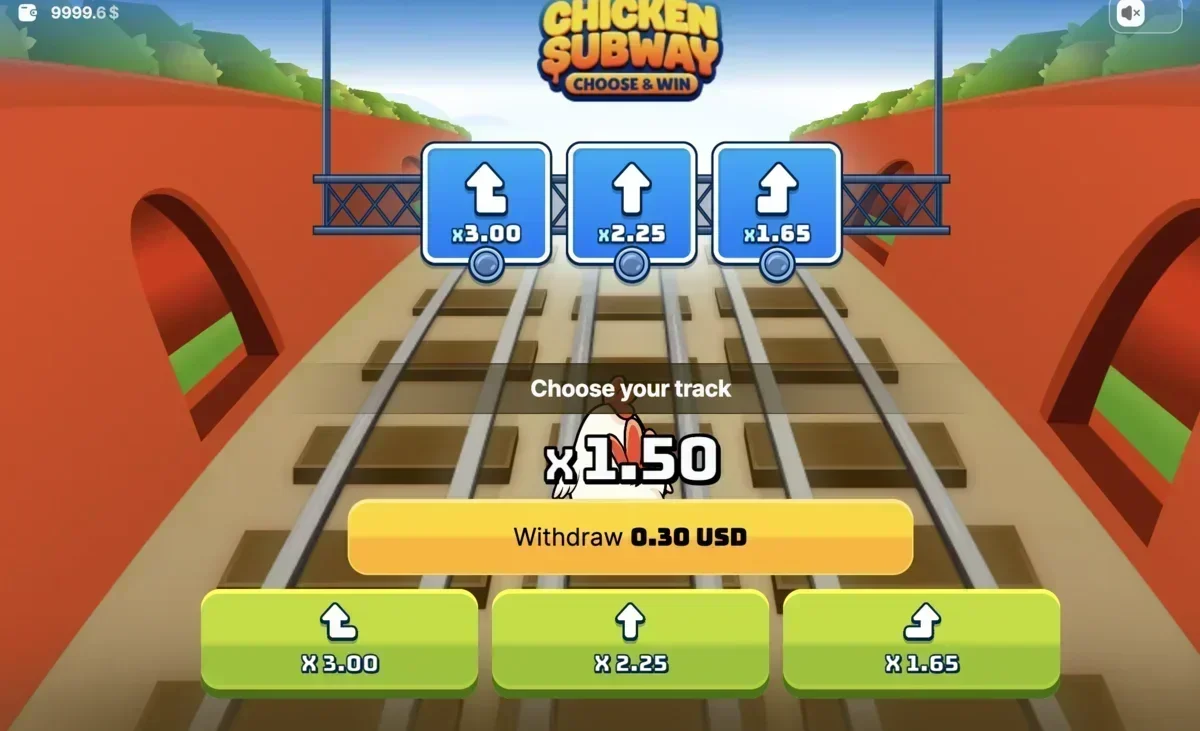
After each successful track selection, you have a choice:
- Withdraw: Take your current winnings (bet × accumulated multiplier)
- Continue: Choose another track to increase your multiplier
There's no wrong answer here. Withdrawing early guarantees a profit but limits upside. Continuing gives higher potential but risks everything.
Multipliers & Paytable
Unlike slots with fixed paylines, Chicken Subway's payouts depend entirely on your choices and when you withdraw. Here's what I observed across 100+ rounds:
Track Multiplier Ranges
| Track Type | Multiplier Range | Risk Level | My Success Rate* |
|---|---|---|---|
| Low (usually left) | x1.10 - x1.50 | Low | ~85% (estimated) |
| Medium (usually center) | x1.50 - x2.50 | Medium | ~60% (estimated) |
| High (usually right) | x2.50 - x6.00+ | High | ~30% (estimated) |
*Based on my personal testing. Actual probabilities are determined by the provably fair algorithm and may differ.
Example Payouts
| Bet | Steps Completed | Final Multiplier | Payout | Profit |
|---|---|---|---|---|
| $10 | 2 low tracks | x1.32 | $13.20 | +$3.20 |
| $10 | 3 medium tracks | x4.50 | $45.00 | +$35.00 |
| $10 | 1 high track | x3.30 | $33.00 | +$23.00 |
| $10 | Exceeded crash point | — | $0 | -$10.00 |
Maximum Payout Cap
Regardless of your multiplier, the maximum payout is $10,000. If you bet $150 and achieve x100 multiplier, you'd theoretically win $15,000 — but the cap limits you to $10,000.
Provably Fair System
This is what separates legitimate games from potentially rigged ones. Chicken Subway uses cryptographic hashing to prove each round's outcome was predetermined and not manipulated.
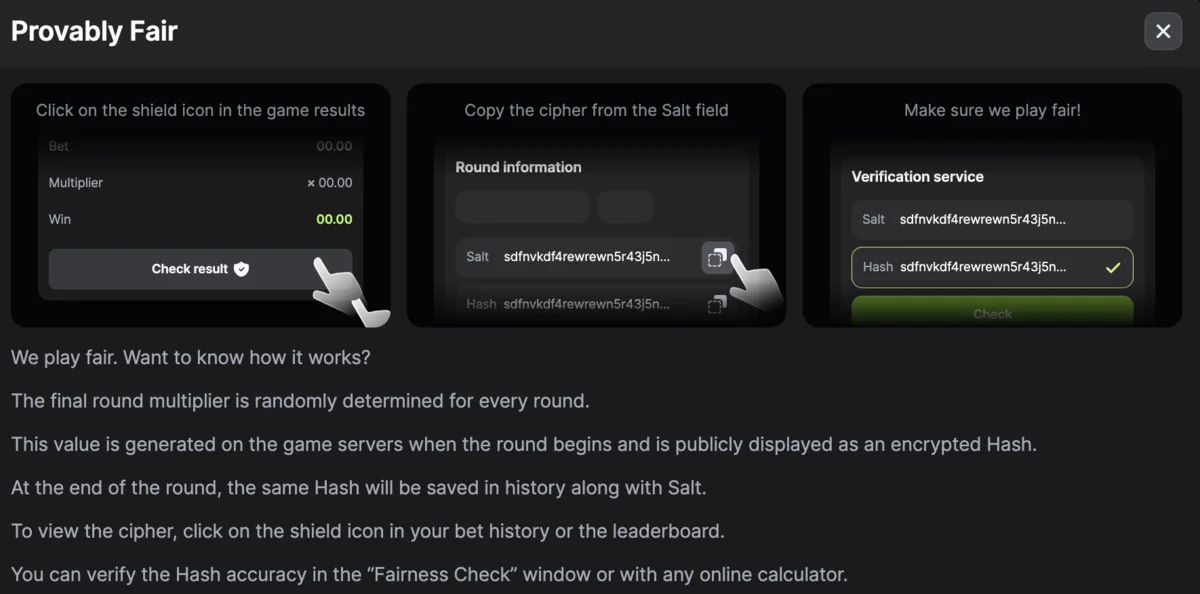
How It Works
- Before round: Game generates a hidden crash multiplier and displays its encrypted Hash
- During round: You make your choices, unaware of the crash point
- After round: Game reveals the Salt value
- Verification: You can combine Salt + crash point, hash it, and compare to the original Hash
How to Verify
- After any round, click the shield icon in your bet history
- Copy the Salt value
- Go to any SHA-256 calculator online
- Enter: Salt + crash multiplier
- The resulting hash should match the Hash shown before the round
I verified 50+ rounds this way — every single one matched. The system works.
Common Mistakes to Avoid
After watching forums and testing myself, these are the errors I see most often:
Mistake #1: Chasing Losses
After losing a few rounds, the temptation is to increase bets to "win it back." This usually accelerates losses. The game doesn't know or care about your previous results.
Instead: Set a session loss limit before playing. When you hit it, stop.
Mistake #2: Always Going for High Multipliers
Those x5.00+ tracks look tempting. But they hit maybe 20-30% of the time. Consistently choosing them means frequent total losses.
Instead: Mix in low-multiplier tracks to build up safely, then occasionally go high.
Mistake #3: Never Withdrawing
Some players keep going until they crash, every single time. This guarantees eventual loss.
Instead: Set a target multiplier (like x2 or x3) and withdraw when you hit it, at least some of the time.
Mistake #4: Betting More Than You Can Lose
This applies to all gambling. Don't bet rent money. Don't bet money you need for bills. Chicken Subway is entertainment, not income.
Instead: Only deposit what you'd spend on a night out. When it's gone, it's gone.
Mistake #5: Ignoring the Timer
There's limited time to make each choice. If you're distracted, the game may auto-select a track you didn't want.
Instead: Stay focused during rounds. If you need a break, withdraw first.
Frequently Asked Questions
What happens if I don't choose a track in time?
The behavior depends on the casino. Most auto-select the middle track. Some auto-withdraw your current winnings. Check the game rules in settings.
Can I see other players' choices?
Some versions have a "Live Bets" panel showing other players' bets and outcomes in real-time. This is purely informational — each player has their own independent round.
Is there an auto-play feature?
Currently, Chicken Subway doesn't have auto-play or auto-cashout features. Each round requires manual input, which adds to the engagement but may not suit everyone.
Why do multiplier values change each step?
The track multipliers are randomly generated each step as part of the provably fair algorithm. Sometimes you'll see three low options, sometimes three high ones. It varies.
Can I play multiple rounds simultaneously?
No, Chicken Subway is a single-bet game. You complete one round (win, lose, or withdraw) before starting another. Some crash games allow dual bets, but this one doesn't.
Does the game have sound?
Yes, there are sound effects for track selection, wins, and crashes. You can mute via the speaker icon in the top right corner. The sounds aren't too annoying, but I play muted personally.
How do I know when to withdraw?
There's no "right" answer — it depends on your risk tolerance and goals. I cover this in detail on the strategies page. Generally, withdrawing at x1.5-x2 is conservative; x3-x5 is moderate; x5+ is aggressive.